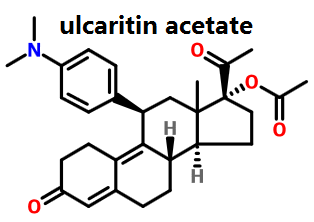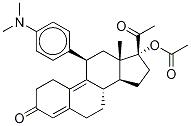
Chemical Properties
Pale Yellow Solid
Usage
Labelled Ulipristal
Usage
Ulipristal acetate is a selective progesterone receptor modulator
Usage
Α selective labelled progesterone receptor modulator
Originator
Research Triangle Institute (US)
Uses
Ulipristal acetate is a selective progesterone receptor modulator
Uses
Α selective labelled progesterone receptor modulator
Definition
ChEBI: A 20-oxo steroid obtained by acetylation of the 17-hydroxy group of (11beta,17alpha)-17-acetyl-11-[4-(dimethylamino)phenyl]-3-oxoestra-4,9-dien-17-ol (ulipristal). A selective progesterone receptor modulator, which is empl
yed as an emergency contraceptive.
Biochem/physiol Actions
Ulipristal acetate is a selective progesterone receptor modulator (SPRM) with tissue-selective partial antagonist activity. It has clinical use both as an emergency contraceptive and as a treatment for uterine fibroids. Ulipristal acetate acts as a partial antagonist on the hypothalamic–pituitary–ovarian axis to inhibit or delay ovulation without affecting human embryo implantation. As a progesterone antagonist, Ulipristal acetate selectively suppresses neo-vascularization, cell proliferation, and survival in uterine fibroid cells, but not in normal myometrial cells.
Clinical Use
Ulipristal acetate, a selective progesterone receptor modulator
(SPRM), was developed at the Research Triangle Institute. In
2009, HRA Pharma received FDA approval for emergency contraception
within 120 h (5 days) of unprotected sexual intercourse or contraceptive failure. Ulipristal acetate is a well-known steroid
that possesses antiprogestational and antiglucocorticoid activity.
It is the first SPRM that was specifically designed as an oral
emergency contraceptive. Unlike earlier levonorgestrel-based
emergency contraceptives, this SPRM drug maintains efficacy for
5 days after unprotected intercourse while having safety profile
comparable to levonorgestrel.
Synthesis
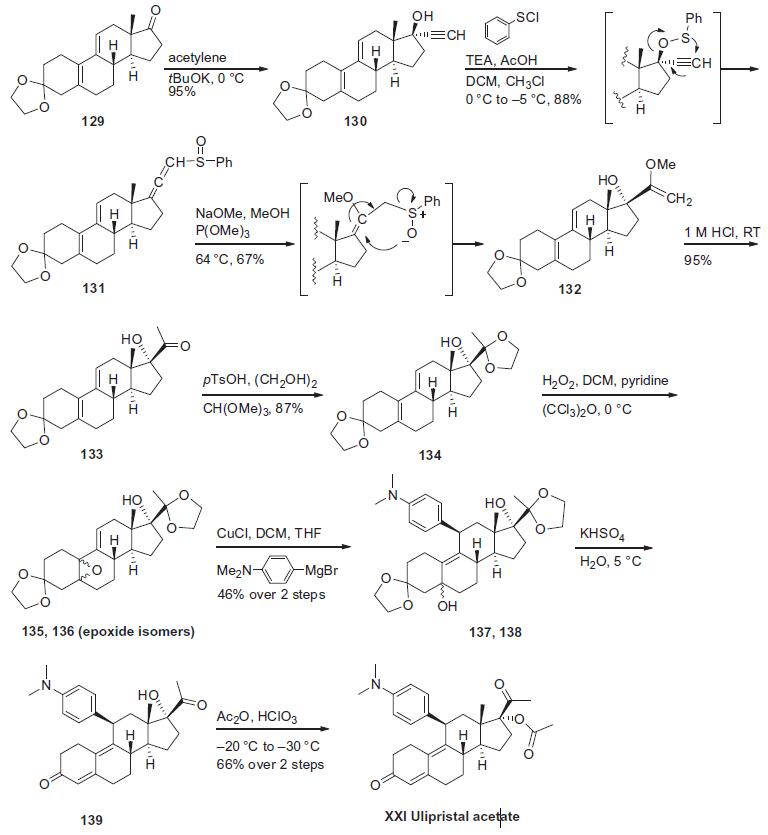
Recently, an industrial scale route
was published and is described in the scheme.89 Alkylation of
commercially available 3-(ethylenedioxy)-19-estra-5(10),9(11)-
diene-17-one (129, multiple vendors) with tBuOK and acetylene
in THF at 0??C gave alcohol 130 in 95% yield, which was subsequently
treated with phenylsulfenyl chloride in the presence of
TEA and AcOH in DCM/CHCl3 at 5??C to 0??C to effect thiolester
formation followed by sulphinate-sulphoxide rearrangement to
give allene sulphoxide 131 in 88% yield. Compound 131 was treated
with NaOMe/MeOH at 64??C to give the corresponding enol
ether and then the enol ether was treated with trimethyl phosphite
at the same temperature for sulphoxide-sulphinate rearrangement
to furnish hydroxyl enol ether 132 in 67% yield. Compound 132
was demethylated with 1 M HCl in methanol to give the corresponding
ketone 133 in 95% yield which was protected using ethylene
glycol, pTsOH and trimethyl orthophosphate in DCM to
afford cyclopentyl ketal 134 in 87% yield. Epoxidation of 134 in
the presence of hexachloroacetone and H2O2 in pyridine and
DCM at 0??C provided a 55:45 mixture of the 5-a,10-a epoxides
(135, 136). The crude epoxides 135 and 136 were reacted with
4-( N,N-dimethylamino)-phenyl magnesium bromide in THF in
the presence of CuCl in DCM to furnish the mixture of diastereomers
137 and 138 in 46% yield over two steps. The mixture (137
and 138) was then treated with KHSO4 in water at 5??C to affect
dehydration and liberation of the keto functional group to give
139 which was used in the next step without isolation. Compound
139 was acetylated with acetic anhydride and perchloric acid in
DCM at 30??C to afford the ulipristal acetate (XXI) in 66% yield
over the final two steps.